“It is not the mountain we conquer, but ourselves.” ― George Mallory
This July, National Geographic continues its Legacy of Exploration by once again venturing to the top of Mount Everest with two bold original specials.
The Everest Specials Complement National Geographic Magazine’s Single-Topic July Issue, which Explores the Mountain’s Unique History Through Science and Storytelling.
Kicking Off the Night of Exploration on 15 July at 19:20, LOST ON EVEREST Sets Out to Solve One of Mountaineering’s Most Enduring Mysteries with Renowned Climber Mark Synnott and National Geographic Photographer Renan Ozturk.
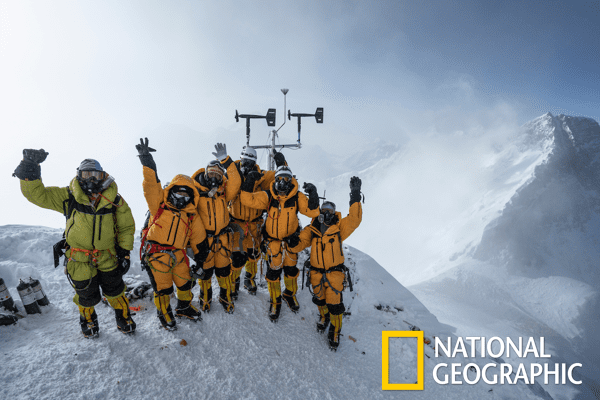
Premiering 22 July, at 19:20, as Part of National Geographic and Rolex’s Perpetual Planet Expedition Partnership and Narrated by Tate Donovan, a Team of Elite Scientists Leads the Most Comprehensive Scientific Expedition to Mount Everest to install the World’s Highest Weather Stations in
EXPEDITION EVEREST
National Geographic has a long, deep-rooted history of traveling to one of Earth’s most extreme environments atop the highest peak in the world — Mount Everest — to investigate, observe and deliver powerful, groundbreaking stories, despite its risks. Since 1933, when the magazine published a story about flying over the mountain for the first time, to the National Geographic’s Society’s first grant in the region in 1948, to National Geographic’s very first television broadcast in 1965, which featured footage shot from Everest for the first time, our yellow border in exploring the mountain has been unmatched.
Continuing its rich legacy of Everest exploration with unparalleled access from renowned explorers, scientists, photographers and filmmakers, National Geographic (DStv 181, StarSat 220) once again ventures to the peak on 15 and 22 July at 19:20 (CAT) to combine high-altitude alpinism with cinematic storytelling for two original premieres: and EXPEDITION EVEREST and LOST ON EVEREST.
EXPEDITION EVEREST
Starting at 19:20 on Wednesday 15 July EXPEDITION EVEREST follows a team of international scientists, climbers and storytellers to the top of the world’s highest peak to conduct the most comprehensive, single scientific expedition in Mount Everest history. The one-hour special, narrated by actor Tate Donovan (“MacGyver,” “The Man in the High Castle”) captures trailblazing climate research that is critical to understanding changes facing the mountain and its glaciers, and shines a light on the threats these changes pose to the communities that live downstream. The groundbreaking mission captures the drama the dedicated, elite expedition team faced and reveals the high stakes and motivations of those who risk their lives to discover the secrets of Everest.
Follow the team, with members from eight countries and half of whom were from Nepal, as they trek higher up the mountain, conducting valuable research along the way:
- In the valleys that surround Everest, geologists faced icy waters to collect sediment samples from the bottom of a lake created by the Himalayas’ melting glaciers.
- In the areas surrounding Everest Base Camp, biologists conducted comprehensive biodiversity surveys at multiple elevations to reveal how plants, animals and insects are adapting to warming temperatures.
- Surveying the famed and notoriously treacherous Khumbu Icefall from above, a team of geographers captured ultra-high-resolution imagery of the entire Khumbu glacier that stretches from base camp all the way up the southern face of the mountain.
- At Everest’s South Col, home to some of the mountain’s strongest winds and bitter cold, climate scientists sought out thousands-of-years-old ice, retrieving the highest ice core ever collected to give them brand-new insight into how the glacier has evolved.
- In the “death zone,” above 7,900 metres, the team braved not only extreme conditions but also dangerous crowding to install the world’s highest weather station, providing near-real-time data on conditions at the roof of the world.
EXPEDITION EVEREST gives a behind-the-scenes look at the National Geographic and Rolex Perpetual Planet Everest expedition, part of a partnership between National Geographic and Rolex to shine a light — through science, exploration and storytelling— on the challenges facing the Earth’s critical life-support systems. By combining National Geographic and Rolex’s shared history of exploration with science-based storytelling, the partnership illuminates the impacts of climate change on our planet and helps to equip communities with tools to bolster their resilience. To learn more about the expedition and the vital role mountain systems like Everest play in providing water resources to nearly a quarter of the world’s population, visit https://www.natgeo.com/everest.
EXPEDITION EVEREST is produced by National Geographic Studios, with Christine Weber serving as executive producer, Katie Bauer Murdock as producer and Katherine Chivers as associate producer.
LOST ON EVEREST
Beginning at 19:20 on Wednesday 22 July, LOST ON EVEREST investigates one of exploration’s most perplexing mysteries: What happened to the great explorers Andrew “Sandy” Irvine and George Leigh Mallory, who disappeared on June 8, 1924, while attempting the first summit of Everest? The clues to solving this mystery lie frozen somewhere near the top of the world’s tallest mountain.
The one-hour special is led by journalist, climber and adventurer Mark Synnott, along with National Geographic photographer, climber and mountaineer Renan Ozturk; they are joined by a world-renowned team of professional climbers with more than 100 combined years of experience on the mountain. Together, they set out to find the body of Everest pioneer Irvine; solve the mystery behind his disappearance; and conclusively determine who successfully conquered the world’s tallest mountain — a feat that would rewrite mountaineering history.
While the main goal was to locate Irvine’s body and camera — Mallory’s body was located in 1999 — the expedition team members unwittingly found themselves also fighting for their lives while on assignment and faced harrowing obstacles, including the following:
- Extreme Weather: Team members found themselves caught in hurricane-force winds of more than 150 Kilometres per hour, which blew tents into the air and threw climbers off their feet — just inches away from the side of the mountain.
- Overcrowding: With high winds and freezing temperatures limiting the window for climbing to only a few critical days, the summit became overcrowded with more than 250 climbers — a condition leading to one of the deadliest climbing seasons in history.
- High-Altitude Threats: Extreme cold mixed with high altitude caused near deadly complications for two members of the team. A cameraman developed blood clots in his lungs, while another climber suffered a minor stroke, forcing both off the mountain for emergency medical help.
LOST ON EVEREST features never-before-seen breathtaking images captured from high-altitude drones and new research from the preeminent Everest historian Tom Holzel, who utilizes state-of-the-art computer software to uncover photographic details. As part of the expedition, Ozturk captured a rare and breathtaking 360-degree panorama photograph of Mount Everest, which was featured in National Geographic magazine in 2019.
More details can be found here.
“No mountain on our planet has been the subject of as much fascination and research as Mount Everest. Completing a climb is a strenuous and potentially deadly undertaking due to the extreme altitude, avalanches, icefalls, and other hazards. Now, new technology in both science and cinematography is opening endless possibilities for exploration and shedding new light on this iconic landmark, which is captured in these two exhilarating documentaries” said Evert van der Veer, Vice President, Media Networks, The Walt Disney Company Africa.
LOST ON EVEREST is executive produced for National Geographic by Taylor Rees and Renan Ozturk, who also directs, with Drew Pulley producing. Serving as executive producers for National Geographic are Bengt Anderson and Alan Eyres, senior vice president of production and development.
NATIONAL GEOGRAPHIC MAGAZINE
In addition to the two National Geographic Everest specials, National Geographic magazine will release a special, single-topic issue spotlighting Mount Everest. The July issue, which includes stunning photography, weaves together the unique history of exploration and discovery on Mount Everest with new, cutting-edge science and storytelling. The issue investigates the quest to solve one of the mountain’s biggest mysteries: Who really summited Everest first? It also explores how climate change is altering the world’s highest peak; delves into new conservation efforts for snow leopards; and provides an exclusive look inside the expedition that built the world’s highest weather station. The special issue is available online June 15 and on newsstands from June 30.
How to tune in:
- DSTV: Channel 181
- StarSat: 220 on DTH, 220 on DTT (249 on DTT in Uganda)