Former Standard Bank Young Artists returns to the National Arts Festival in Makhanda
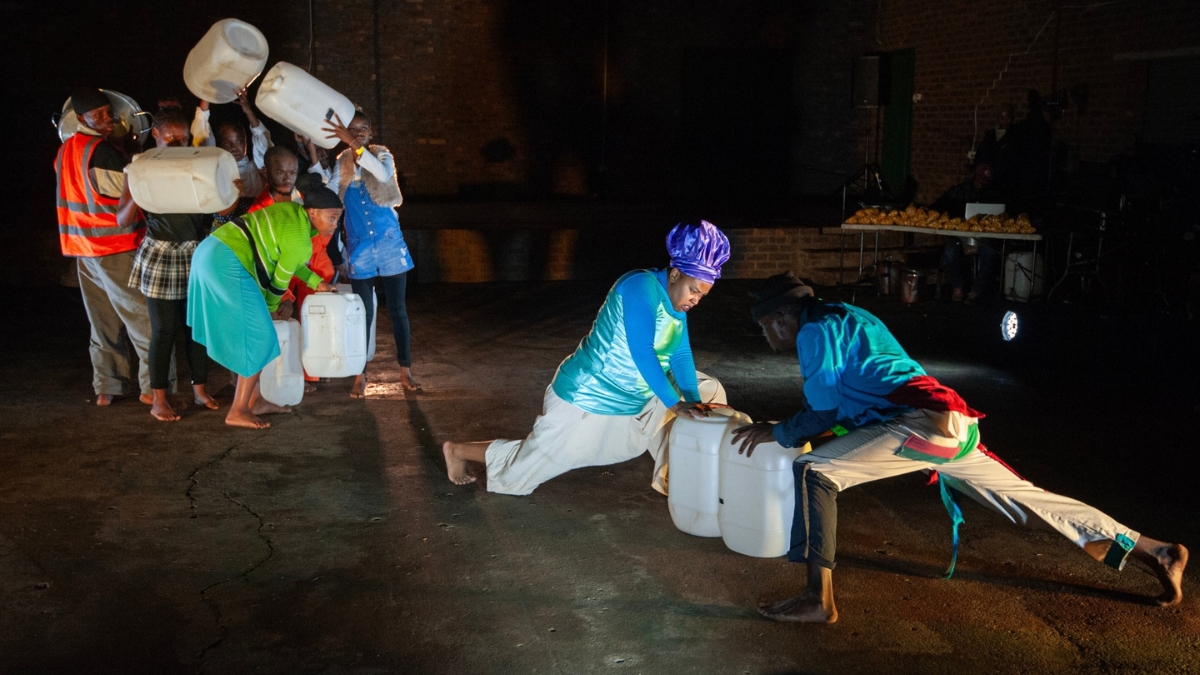
The people in the queue are instantly familiar: there’s the car guard, the gogo with her cooking pot, the slay queen flirting to get a better spot. They are waiting for water, but none comes. Someone jumps the queue, someone pays to get ahead, tempers flare – but still no water.
It’s a basic human right, one you take for granted until you don’t have it. From major cities to small towns, failing water systems have been in the news as a symptom of all that goes wrong when corruption, decaying infrastructure and poor service delivery combine, leaving citizens angry.
Corruption is everybody’s business, but sometimes it takes the artists to show us the mirror. (Co)Ruption, a new dance theatre work by Fana Tshabalala, performed by graduates from the Forgotten Angel Theatre Collaborative (FATC), does just that – showing us how we collaborate in creating the problem.
Tshabalala, a long-time associate of The Forgotten Angle Theatre Collaborative and a former Standard Bank Young Artist for Dance (2013), created the work last year as a commission – part of Artists Against Corruption’s drive to find strong voices to lead a national conversation about corruption – and is proudly offering it as part of this year’s National Arts Festival programme.
Tshabalala says:
“I wanted to do something about an issue that affects everyone – water. I find it shocking and surprising that people are doing corruption that affects basic human needs. Electricity, we can survive without it, but we can’t survive without water. And I was very interested in those people, the ‘mafias’ the mafia tanks, where they make sure that there’s no running water so that their projects can be funded, or the people with water tanks, who deliver water to the community, and then dump the water so that they can get another tank the next day.”
The Forgotten Angle Theatre Collaborative returns to the National Arts Festival
Performed by a group of nine young people who have been through the Forgotten Angle’s youth and skills development programme, the piece represents the beautiful fruition of a long story in the making – a story of two Standard Bank Young Artists, artists growing with the times, and returning to the National Arts Festival to tackle issues of urgent national importance.
PJ Sabbagha, CEO of FATC, and SBYA 2005, says:
“NAF has been a critical career builder for me. This year FATC returns with a team of young artists who will perform alongside seasoned FATC Angels Fana Tshabalala and Nicho Aphane, in the theatre that was my creative and choreographic studio in the early 1990’s. I am excited by the wonderful sense of home coming and sharing this formative space with the young rural artists. It is also quite poignant that we are coming to NAF with a creative provocation that reflects our shared, lived South African crisis around water and corruption.”
This will be FATC’s 13th production on the curated programme, presenting three productions by members who received Standard Bank Young Artist Awards – Tracey Human (2001), PJ Sabbagha’s Petra (2005), and Fana Tshabalala’s Indumba (2013), and then PJ Sabbagha’s Macbeth (2007), There’s no more room in this bed (2003); The double room (2002), Zebra (2009) & Noise (2018), PJ Sabbagha and Sylvaine Strikes’ Cargo Precious (2014), Mamela Nyamza’s Phumalanga (2019), Janeth Mulapha and Jenni-Lee Crewe’s (In)visible (2023), and now Fana Tshabalala’s (Co)Ruption (2026).
Small towns, festivals and water crises
The piece featured earlier this year at the My Body My Space festival – the small-town public arts event in Mpumalanga that brings the streets of Entokozweni (Machadodorp) alive every year in March. Brainchild of PJ Sabbagha and members of FATC, The My Body My Space festival is designed to use public space in a way that forces spectators, to ask questions about where we live, how we treat common property, whose responsibility it is to keep our environments healthy, and how we encounter each other in those public spaces.
This unique festival highlights the challenges facing small towns across rural SA: jobs are scarce away from the urban centres, municipalities lack capacity, roads are potholed, and the signs of poverty are everywhere. Liquor shops are busy at 10am, but you are not sure if the water is ok to drink. Makhanda, the National Arts Festival host city, is no exception.
Tshabalala reflects on this further:
“So, the piece is about the greediness of people, and about what we have become as a society. And I keep on wondering to myself, good, what’s happening in their mental state? How do you deprive people of water and how can you do corruption with water? Just imagine, you are a serial killer, if you’re doing that. And there are people who take the same water that they collected for free, and they sell it to others. And when we had discussions with the dancers, and with the public, 90% of them said, this is how the world is. If I get an opportunity, I’ll probably do the same thing.”
If we admit that we are all part of the problem, perhaps that means we can part of the solution too?
Blending physical theatre, humour, tension and a bold live-generated soundscape, (Co)Ruption moves beyond issue-based protest into something deeply human and unsettlingly familiar. With no dialogue and broad cross-cultural appeal, the production invites audiences not only to recognise the systems around them, but to ask difficult questions about moral choices, survival and accountability.
Provocative, entertaining and painfully recognisable, (Co)Ruption is dance theatre that sparks conversation long after the performance ends.
(Co)ruption was conceptualized and developed in 2025 for Artists Against Corruption, a co-designed, collaborative anti-corruption Arts initiative aimed at confronting social norms that perpetuate a culture of corruption. This was initiated and supported by the Deutsche Gesellschaft für Internationale Zusammenarbeit (GIZ) GmbH – Transparency, Integrity & Accountability Programme (TIP) in South Africa.
The work is performed by FATC learners/interns and Graduates.
The Forgotten Angle Theatre Collaborative acknowledges The Oppenheimer Memorial Trust and the National Arts Council for their ongoing support of its training programmes.
Show Details:
- Dates & Times:
- 2nd July 18:00
- 3rd July 19:00
- 4th July 12:00
- Venue: Rhodes Theatre
- Tickets: From R120 available online here
- Duration: 60 minutes
About The Forgotten Angle Theatre Collaborative
The Forgotten Angle Theatre Collaborative (FATC) is a rural based South African arts organisation with a 30-year history of creating innovative, socially engaged performance work while nurturing artistic talent in underserved communities. Based at the Ebhudlweni Arts Centre in rural Mpumalanga, FATC has built an international reputation for contemporary dance theatre, public arts festivals and arts activism, with collaborations and touring work across Africa, Europe and beyond. Alongside its acclaimed artistic programme, FATC delivers extensive skills development and training initiatives for children, youth, women and people with disabilities, creating pathways into the creative industries through arts education, mentorship, residencies and community-based cultural programmes.
Connect with The Forgotten Angle Theatre Collaborative on social media:
Facebook | Instagram
The National Arts Festival takes place from 26 June – 6 July in Makhanda in the Eastern Cape. The full programme can be viewed here. Tickets can be purchased online here.
The National Arts Festival is South Africa’s largest multi-disciplinary arts event, operating continuously since 1974. Held annually in Makhanda (formerly Grahamstown), the Festival presents new and established work across theatre, music, dance, comedy, literature, visual art, and experimental forms. The Festival serves as a key platform for South African cultural production, artist development, and international cultural exchange.
Connect with the National Arts Festival Makhanda on social media:
Facebook | Twitter | Instagram | TikTok | Website